
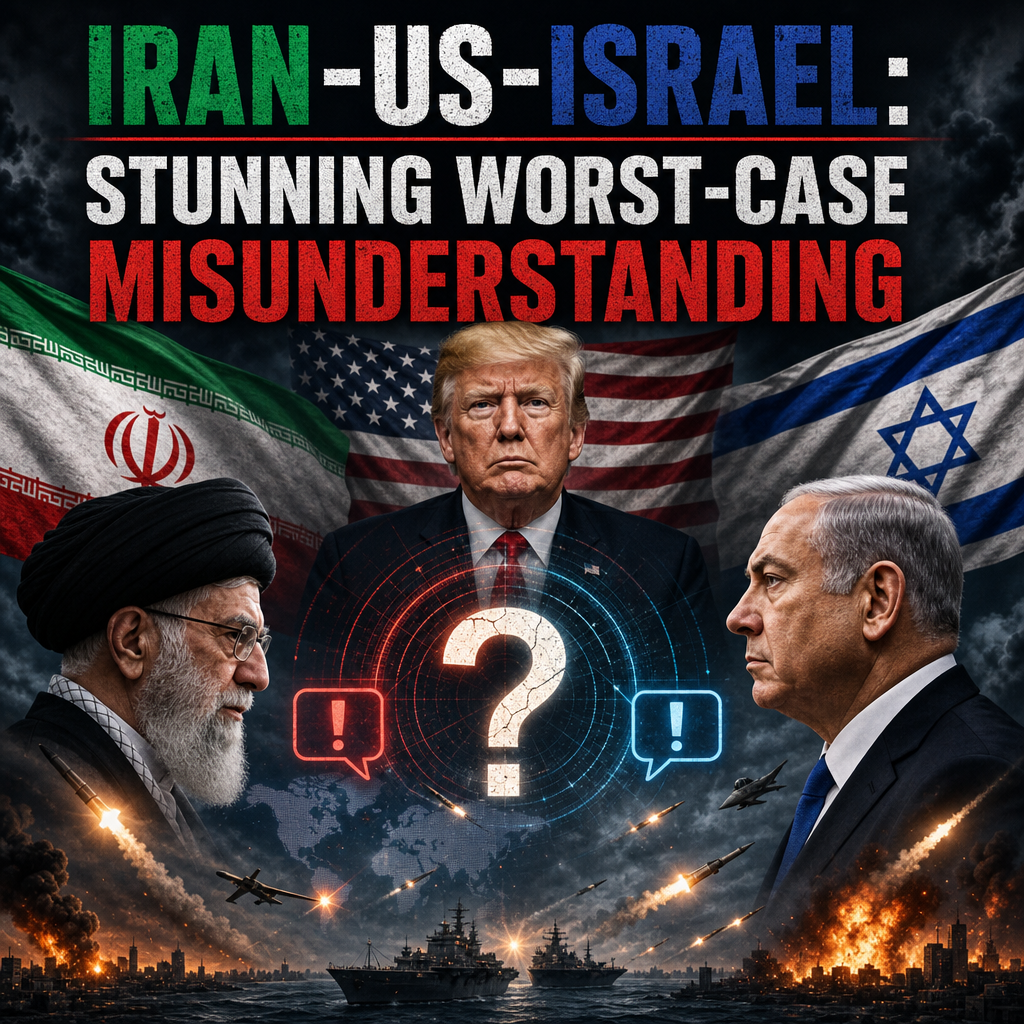
Iran-US-Israel: Stunning Worst-Case Misunderstanding


Iran-US-Israel tensions are a reminder that the most dangerous moments in geopolitics are not always caused by a single dramatic decision, but by a chain of misread signals, rushed assumptions, and competing narratives. In this case, the fear is not only that the three sides are heading toward a wider confrontation, but that each believes it is acting defensively while the others see provocation.
The discussion now unfolding across international coverage has a striking pattern: everyone agrees the risk is real, but they disagree sharply on why it is happening and who is driving it. That disagreement matters, because in a region where military moves, proxy attacks, and diplomatic warnings can all be interpreted as preparation for war, misunderstanding itself can become the spark.



Iran-US-Israel and the danger of reading the room wrong
What makes the current standoff so alarming is that it sits in a gray zone between deterrence and escalation. Al Jazeera’s reporting and commentary has tended to frame the crisis within a broader regional and political context, stressing that any confrontation between Iran, the US, and Israel does not stay neatly contained. It quickly pulls in Lebanon, Syria, Gaza, the Gulf, and global energy markets. That wider lens is important: even limited strikes or covert actions can create consequences far beyond the original target.
From that perspective, the real issue is not just military capability but intent. Iran may view its actions as signaling resilience and deterrence. The US may see pressure as necessary to contain escalation and protect allies. Israel, facing existential security concerns, may interpret hesitation as an invitation to act first. When all three sides assume the others are planning for the worst, the margin for error gets tiny.




Sky News coverage, by contrast, often reflects the immediate security and diplomatic anxiety felt by Western policymakers. The focus is less on the historical roots of the conflict and more on the practical question: how close are we to a direct clash, and what would it mean for civilians, oil flows, and international stability? That angle is useful because it strips away rhetoric and puts attention on the likely costs of miscalculation. The answer is uncomfortable: even if no side wants a full-scale war, any one of them could still stumble into one.
Why misunderstanding can be more dangerous than hostility
There is a difference between open hostility and dangerous confusion. In open hostility, each side understands the basic boundaries of the conflict, even if they reject them. In a misunderstanding, those boundaries become unclear.
That is what makes the phrase “worst-case misunderstanding” so apt. A drone strike may be read as a message when it was intended as a warning. A retaliatory operation may be framed as limited when the other side experiences it as a declaration of war. A diplomatic pause may be interpreted as weakness. Even statements designed to calm tensions can sound threatening if mistranslated through existing suspicion.
RT’s coverage commonly pushes hard against the US and Israeli narrative, often emphasizing the possibility that Western powers are escalating while publicly claiming restraint. Whether readers agree with that framing or not, it highlights an important truth: information warfare is now part of the battlefield. Each camp tries to shape how the other side’s actions are understood, not just what those actions are.
That makes independent verification harder and propaganda more effective. It also means the public is often seeing only fragments of a bigger strategic picture.
Iran-US-Israel: different narratives, same risk
The most striking thing across the sources is not consensus on blame, but consensus on danger. That shared concern comes from different places:
– Al Jazeera emphasizes regional spillover and the political complexity of escalation.
– Sky News focuses on the immediate security implications and the risk of direct confrontation.
– RT stresses the possibility that US and Israeli actions could be provoking the crisis rather than preventing it.
Taken together, those viewpoints suggest a broader conclusion: the conflict is being shaped as much by perception as by force. In a situation like this, the side that believes it is deterring war can be the same side that makes war more likely.
There is also a deeper irony here. Each actor likely sees itself as responding rationally to the others’ behavior. Iran wants deterrence. The US wants containment and credibility. Israel wants preemption and survival. Yet when rational strategies collide inside an atmosphere of fear, they can produce irrational outcomes.
The civilian cost is the part nobody can afford to misread
It is easy for leaders to speak in terms of red lines, strategic assets, and regional balance. But if escalation continues, the consequences will be measured in far more concrete terms: disrupted shipping, damaged infrastructure, displaced families, and the possibility of a broader regional war.
That is why caution is not weakness. It is realism. The public messaging from all sides often sounds confident, but confidence is not the same thing as control. The history of this region suggests that once a crisis begins moving faster than diplomacy, leaders often discover too late that their assumptions were wrong.
The hardest truth may be that no side needs to intend a catastrophic outcome for one to happen. All it may take is a chain reaction of interpretation errors: a strike seen as a signal, a warning read as a bluff, a pause mistaken for a trap. That is the essence of the worst-case misunderstanding.
The result, if avoided, will not be due to luck alone. It will require clearer communication, tighter restraint, and a willingness to assume that the other side may be misreading the situation just as badly as you are. In a crisis this charged, that kind of humility may be the only thing standing between brinkmanship and disaster.

























